
Titanium Implant Protect Insert Kit for Satelec Acteon - Acteon Satelec
Brand:Acteon Satelec
Reference:F02120
Manufacturer Ref.:F02120
-30%
66090€
Price VAT included(0%)€660.90
Recommended price€944.14
Satelec insert kit for the treatment and maintenance of periimplantitis
- Kit for the deep cleaning and maintenance of peri-implantitis treatments
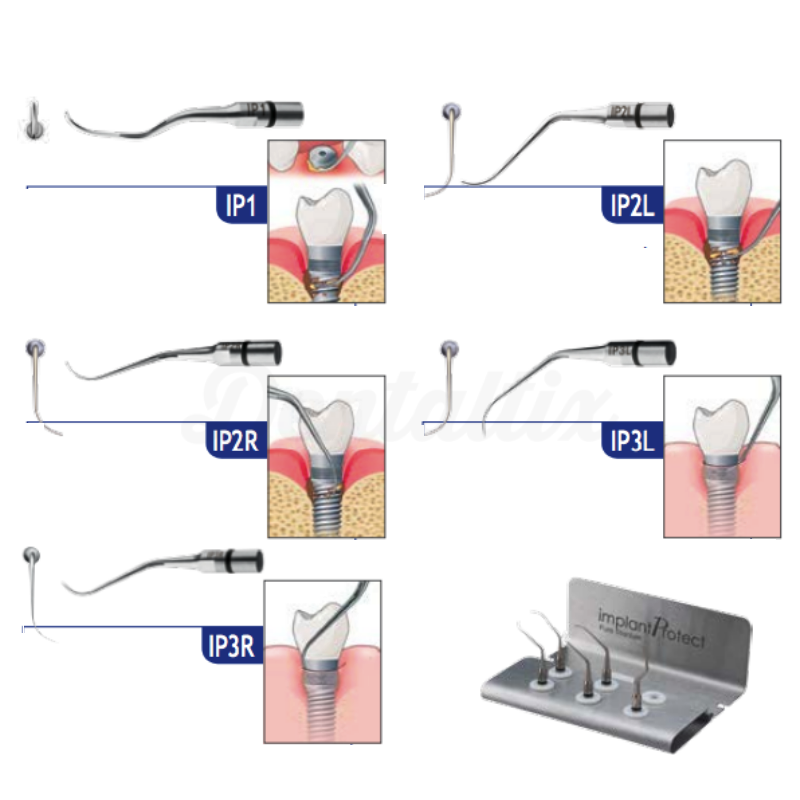
- Manufactured in the same way as titanium implants in to preserve its intact surface, composed of the following inserts: IP1, IP2L, IP2R, IP3L and IP3R.
- Includes wrench and autoclavable metal case
66090€
Email me when it's back in stock
 You have 15 days to return it.
Description
SATELEC IMPLANT PROTECT INSERT KIT
Inserts for the treatment and maintenance of periimplantitis.
- Kit for the deep cleaning and maintenance of peri-implantitis treatments the best solution for combatting this clinical disease
- Manufactured like most titanium market implants, enabling preservation of its intact surface. Prevents the transfer of material and clinical wear of the layer on the implant.
- Composed of the following Inserts: IP1, IP2L, IP2R, IP3L and IP3R 1.
- Includes wrench and autoclavable metal case
Features:
- IP1: For the surface area of implant pillars and wide supports.
- Tip with a wider active end, for debridements and cleaning, can be used without surgery in implants without mobility and pockets less than 5mm
- Recommended for implants without bone loss (about 2mm)
- IP2L: For the intermediate area of the implant, angled left.
- The left angulation allows its use without surgery as well as in surgery, for the cleaning and debridement of the middle third of the implant, thanks to its curvature it fits perfectly even without visibility, easy handling thanks to the tactile perception the titanium provides
- IP2R: For the intermediate area of the implant, angled right.
- The right angulation allows its use without surgery as well as in surgery, for the cleaning and debridement of the middle third of the implant, thanks to its curvature it fits perfectly even without visibility, easy handling thanks to the tactile perception the titanium provides
- IP3L: For narrow implant threads, extra fine active part, angled left.
- For use in the end, the surface button’s finest tip enables the cleaning and revision of the narrowest areas
- IP3R: For narrow implant threads, extra fine active part, angled right.
- For use in the end, the surface button’s finest tip enables the cleaning and revision of the narrowest areas
Product information:
- Manufacturer: SATELEC
- Manufacturer Reference: F02120
Contents:
- Inserts: IP1, IP2L, IP2R, IP3L and IP3R 1.
- Sterilisable wrench.
- Stainless steel case, sterilisable in autoclave.
Questions and answers
There are no questions yet. Be the first to ask one!