Since Sanford Christie Barnum introduced the idea of dental isolation during dental procedures in 1864, and with subsequent developments in 1882 by S.S. White, it has become an essential practice for everyday dental procedures. In this blog post, you will learn all about rubber dams and their importance in endodontics and dental surgical interventions... Interested? Keep reading!
Uses of Rubber Dams:
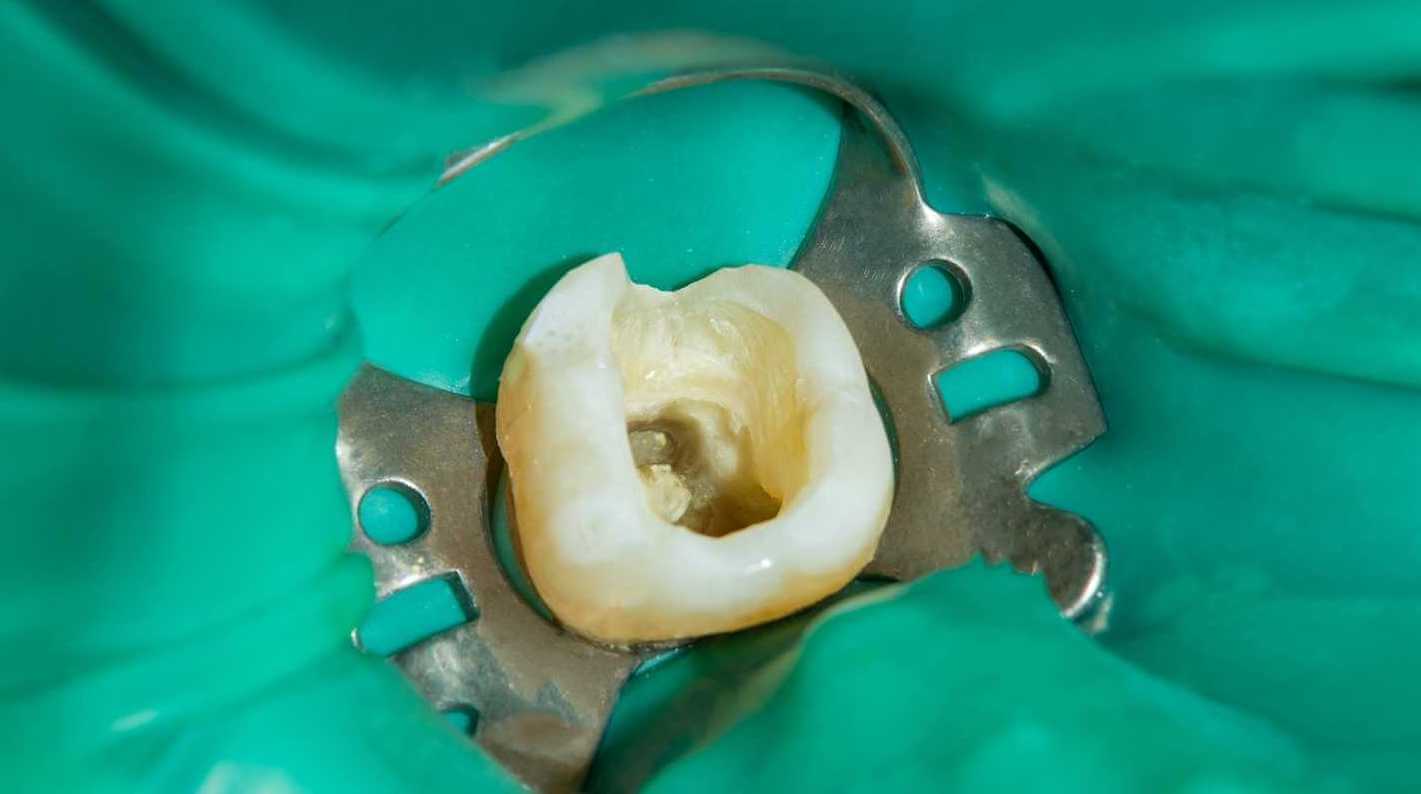
Dental dams are primarily used in procedures that require adhesion or the use of irritating chemicals. The barrier created by the dam between the hard surface of the tooth and the soft tissues (lips and tongue) not only ensures that the patient does not experience tissue damage from these products, but also keeps the oral cavity free of fluids or debris that could compromise the procedure.
Another benefit of using dental dams is that they prevent the risk of the patient swallowing or choking on any dental tool or instrument used by the dentist.
Finally, the greatest benefit of using dental dams is that they greatly increase the visibility of the working area for the dentist, thus reducing the possibility of human error and the duration of the procedure.
However, having said that, there are some issues that dental professionals should consider when deciding to use rubber dams during dental isolation:
- Ensure that the patient does not suffer from allergies, as many dental dams contain, for example, latex. Some rubber dams, such as the VIDU rubber dam, are low in protein, the main cause of allergic reactions to products containing latex.
- The dentist must also be careful with the placement of the dam. In some cases, the use of a dam restricts breathing. This is easily resolved by trimming the rubber dam around the nose and ensuring that the patient has proper breathing before beginning the procedure.
Features of Rubber Dams:
Rubber dams may look very similar, but there are some really important differences that you should consider when stocking your clinic.
- Thickness: Rubber dams are available in various thicknesses to suit different needs. Not all brands offer every thickness, but as a general rule, there are 5 thicknesses: Thin, Medium, Thick, Extra Thick, and Specialty Thickness.
- Size: Almost all rubber dams are 6 x 6 inches in size. For children and patients with smaller oral areas, you can find 5 x 5 inch dams.
- Color: The choice of dam color is entirely up to the dentist. Dental dams are usually brightly colored, such as blue, green, and pink, so that the white teeth stand out against the rubber and maximize visibility.
Although rubber dams must be disposable, as they are not made of sterilizable material and are rarely recyclable due to the contamination and biohazard they pose, this does not mean they cannot be used in an environmentally conscious way. In collaboration with The Gravity Wave, we have created VIDU rubber dams, which offset the weight of plastic used in their manufacture. They also come in recyclable packaging, so you can be confident that your practice is not harming the planet.
Check out our best-selling rubber dams:
The Dental Dam Punch
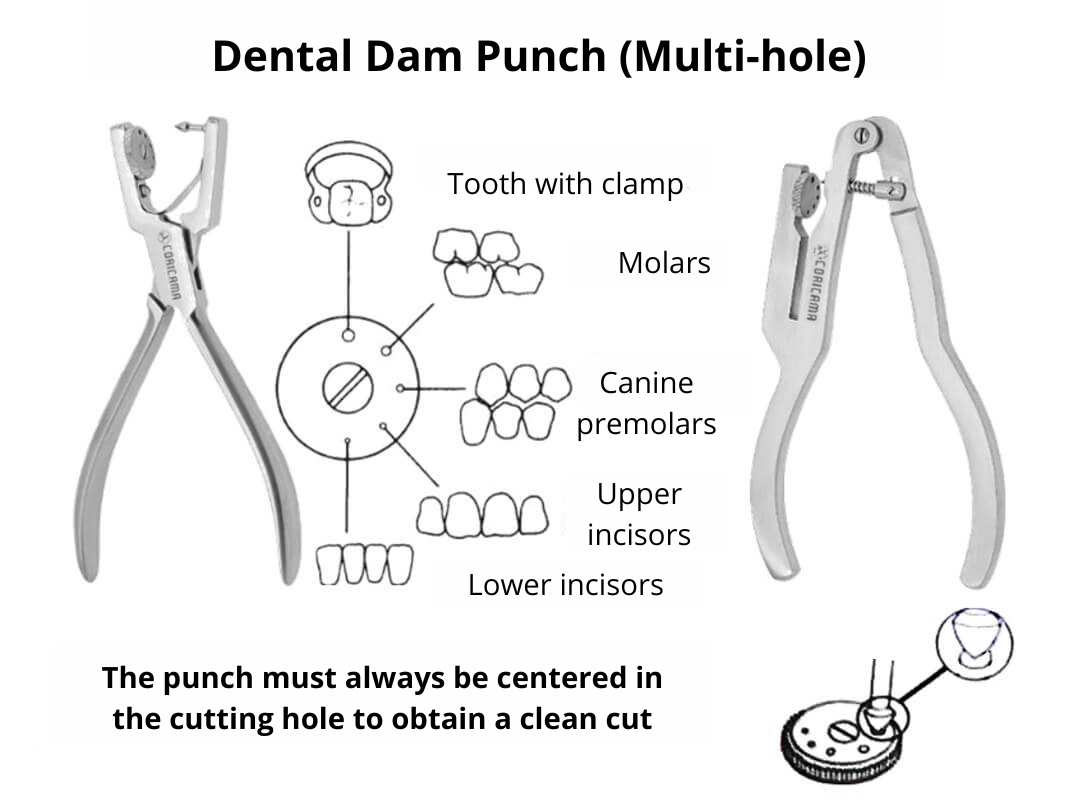
Another key instrument in the isolation process is the dam punch. When the dams arrive at the clinic, they are simply a square of rubber. The dentist must use a dam punch to mark and make holes in the dam adapted to each patient's mouth and dental structure. Each punch has a rotating disc that allows the dentist to select the necessary hole size, which typically ranges from 2 mm holes for molars to 1.5 mm holes for anterior and smaller teeth. The following diagram helps to conceptualize how the dam punch works.
You can take a look at all the dam punches at Dentaltix in their specific category.
Other instruments that will appear on the scene:
There are a few more things you might need to perform absolute isolation, and whether you find them useful depends on how you like to carry out this procedure. In any case, here are some things that dentists use to facilitate the process:
- Water-based lubrication at the corner of the mouth to prevent irritation of the patient's skin.
- Dental floss, used as a safety measure to prevent the clamp from being swallowed or the patient from choking, and also used to help the dentist push the dam precisely between the teeth.
- Dental dam frame or Young's frame - a U-shaped piece of metal or plastic used to stretch the dam and facilitate access to isolated teeth.
- Plastic clamps - sometimes used because they are non-metallic and therefore do not interfere with radiography. However, they have been observed to be less strong than metal clamps and are therefore used less frequently.
- Clamp Holders or Clamp Holders: As the name suggests, these are used to securely insert the clamp. We have a specific section on our site that allows you to view, compare, and read reviews of clamp holders.
- Wedges - These can be used to further stretch the rubber dam and ensure it is properly secured in the tooth socket. They are also used to create space between the teeth and to secure a matrix if necessary.
We hope you found this article about rubber dams for dental isolation very helpful. Do you have any questions or suggestions? Stay in touch and let us know how it goes through our social media channels.
Good luck! See you next time!