Astringents are key chemical agents for controlling gingival recession. Their main function is to help dry and contract soft tissues, allowing for better visibility of the operative field and ensuring that procedures such as impression taking or cementation are performed successfully. By reducing cell permeability and drawing out fluids, astringents facilitate the management of bleeding and moisture, factors that can interfere with the final result of dental restorations. The correct use of these products is essential for obtaining a clean and uncomplicated working space.

Gingival retraction is fundamental in many restorative procedures, such as impression taking, cementation, and restoration placement. To access the preparation margin, adequate retraction is essential to allow for clear visibility and effective control of the operative field. However, retraction is not just about creating space; it also involves managing hemostasis and moisture control, two essential but difficult aspects to achieve simultaneously.
In this article, we will explore the different retraction methods available and how to choose the most appropriate one for each clinical situation, helping to pave the way for success in every procedure.
Challenges of Gingival Recession: A Confined and Complex Space
The oral cavity is not the most favorable environment for performing complex procedures. The limitations imposed by the lips, tongue, cheeks, and gums, along with the position of the teeth, make this confined space a challenge for any dental professional. Furthermore, the gums can bleed for multiple reasons, such as plaque buildup or inflammation, even before dental instruments are introduced. Adding to these factors, some patients take medications that increase blood flow, further complicating hemostasis.
To make matters worse, many dental products require a dry operating field to avoid interference from fluids that could compromise the final result. The use of materials such as cements or adhesives, which are highly sensitive to moisture, demands absolute control over bleeding and fluids. It is at this point that gingival retraction becomes a crucial procedure. But how can these obstacles be overcome efficiently and without compromising patient safety?
Gingival Retraction Methods
There are several gingival retraction techniques, which can be classified into three main categories: mechanical, chemical, and surgical. Each has its advantages and disadvantages, and the selection of the appropriate method will depend on the clinical case and the procedure being performed.
Mechanical Methods
Mechanical methods involve the physical displacement of gingival tissue (with retraction cords or pastes) to clear the preparation margin (1). The use of retraction cords is the most common within this category. These cords are inserted into the gingival sulcus to retract the tissue, control fluids, and exert pressure to stop bleeding. Depending on the case, single-type threads or the double-thread technique can be used, where a thinner thread is placed underneath and a thicker one on top to achieve more effective retraction (2).

Although mechanical methods are effective, they have limitations. Placing the cords can be a slow process that depends on the operator's skill, and improper handling can damage the gingival epithelium, leading to problems such as gingival recession or exposure of the restoration margin. Furthermore, some patients find cord placement uncomfortable or painful.
Chemical Methods
Chemical retraction methods include the use of solutions, gels, or pastes that interact with the tissues to achieve retraction. These substances can be astringents, hemostatic agents, or vasoconstrictors, each with a specific effect on tissues.
- Astringents: These products react with the proteins in soft tissues, decreasing their permeability and drawing out fluids, resulting in tissue contraction. Examples of astringents are ferric sulfate and aluminum chloride.
- Hemostatic Agents: These compounds help control bleeding induced by the dental procedure by promoting clotting.
- Vasoconstrictors: These constrict blood vessels, thus reducing blood flow to the area and facilitating hemostasis. An example is epinephrine.
Let's delve a little deeper into some of the most commonly used chemical retraction options: ferric sulfate (Fe₂(SO₄)₃), epinephrine, and aluminum chloride (AlCl₃).
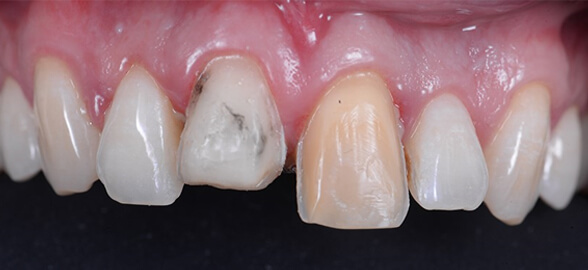
- Ferric sulfate (Fe₂(SO₄)₃): is an astringent with hemostatic properties that is frequently used in conjunction with retraction cords. It is very effective in rapidly clotting the blood, but its use must be handled with care. Due to its acidity, it can cause tissue irritation and affect the tooth surface if not completely removed. Furthermore, excessive use can cause temporary brown or black staining of the gums and teeth; Therefore, it is important to avoid excess before application, keep the preparation and dentin clean during the procedure, and rinse with water after use.
- Epinephrine: is a vasoconstrictor that reduces blood flow by constricting the blood vessels in the treated area. It is very effective for controlling hemostasis, but is not recommended for patients with hypertension or heart problems, as it can increase heart rate and blood pressure.
- Aluminum Chloride (AlCl₃): is one of the most popular astringents due to its effectiveness and low irritation compared to other compounds. It is used impregnated in threads or within pastes and gels, such as the 3M Astringent Retraction Paste, which is then used independently or in combination with the threads. It reacts with blood proteins, creating a barrier that stops bleeding and provides a dry field. Although less aggressive than ferric sulfate, it also requires thorough cleaning, as it can interfere with the setting of certain impression materials.

Whichever chemical solution is selected, it is crucial to apply it only for the recommended time. Once the operative field is dry, it is essential to completely remove the chemical and rinse thoroughly, as residues could interact with impression materials, adhesives, or cements. Furthermore, it is important to remember that these chemical methods are designed exclusively for the gingival sulcus; they should not be applied to the preparation. As with many dental products, precision and proper timing are essential, but if used carefully, potential complications can be minimized.
Surgical Methods
In more complex cases, surgical retraction may be necessary. This approach involves the removal or cauterization of soft tissue to create sufficient space between the gingiva and the preparation. Although these methods are effective, they are more invasive and are only recommended for specific clinical situations, such as in patients with gingival hyperplasia or severe inflammation.
Combination of Methods
It is not always possible to achieve complete retraction with a single method. In many cases, a combination of techniques offers better results. For example, the use of retraction cords impregnated with astringents or vasoconstrictors combines the benefits of mechanical displacement with chemical control of bleeding and moisture. This combination ensures efficient retraction without damaging the surrounding tissues.
Gingival Retraction with Astringent Pastes
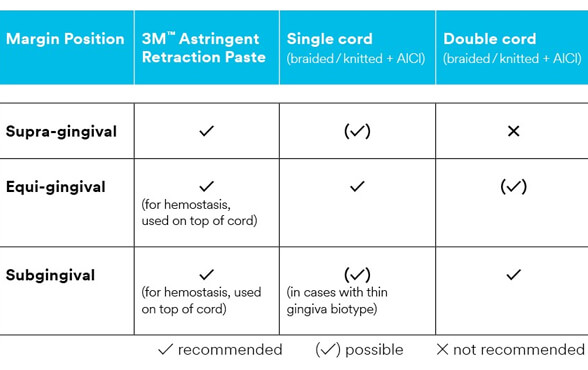
An increasingly popular alternative to retraction cords is the use of astringent pastes, such as the 3M Astringent Retraction Paste. These pastes are designed to retract tissues quickly, efficiently, and less invasively. The paste is applied directly to the gingival sulcus using an extra-fine tip that facilitates access to the preparation margin.
How to Use 3M™ Astringent Retraction Paste?
- Extract a small amount of paste and discard it.
- Insert the tip into the gingival sulcus and apply the paste slowly until the margin area is filled.
- Leave the paste on for at least two minutes.
- Rinse thoroughly with air-water and suction.

This method is especially useful in juxtagingival or supragingival preparations, where mechanical retraction could be excessive. Furthermore, the retraction paste is much more comfortable for the patient and saves time during the procedure.
Take a look at the retraction and astringent threads:
View all gingival retraction material!
Gingival retraction, along with hemostasis and moisture control, is key in dental restorative procedures. With a wide range of methods available, it is essential to select the most appropriate approach for each clinical case.
Astringents, in particular, are indispensable tools that allow you to control bleeding and ensure that the operating field is dry, thus facilitating the taking of accurate impressions and the placement of successful restorations. Whether using retraction cords, astringent pastes like 3M Astringent Retraction Paste, or a combination of techniques, having the right method can make the difference between a predictable and an unsatisfactory result.
With the correct selection and application of retraction techniques, dentists can pave the way for more precise and durable restorations, thus ensuring the success of their procedures and the satisfaction of their patients.
We hope you found this post helpful. To stay up-to-date, follow us on our social media channels where we'll share more articles, useful information, offers, and promotions in the dental sector. We look forward to seeing you there!