Did you know that dental wax is used in many different ways? And not only that, but they all have their own characteristics, properties, compositions and indications. In this article we will tell you everything about dental waxes and how to classify them according to their use, so that it is much easier for you to find the most appropriate dental wax for each clinical or laboratory application. Let us begin!
What are dental waxes and what are their physical properties?
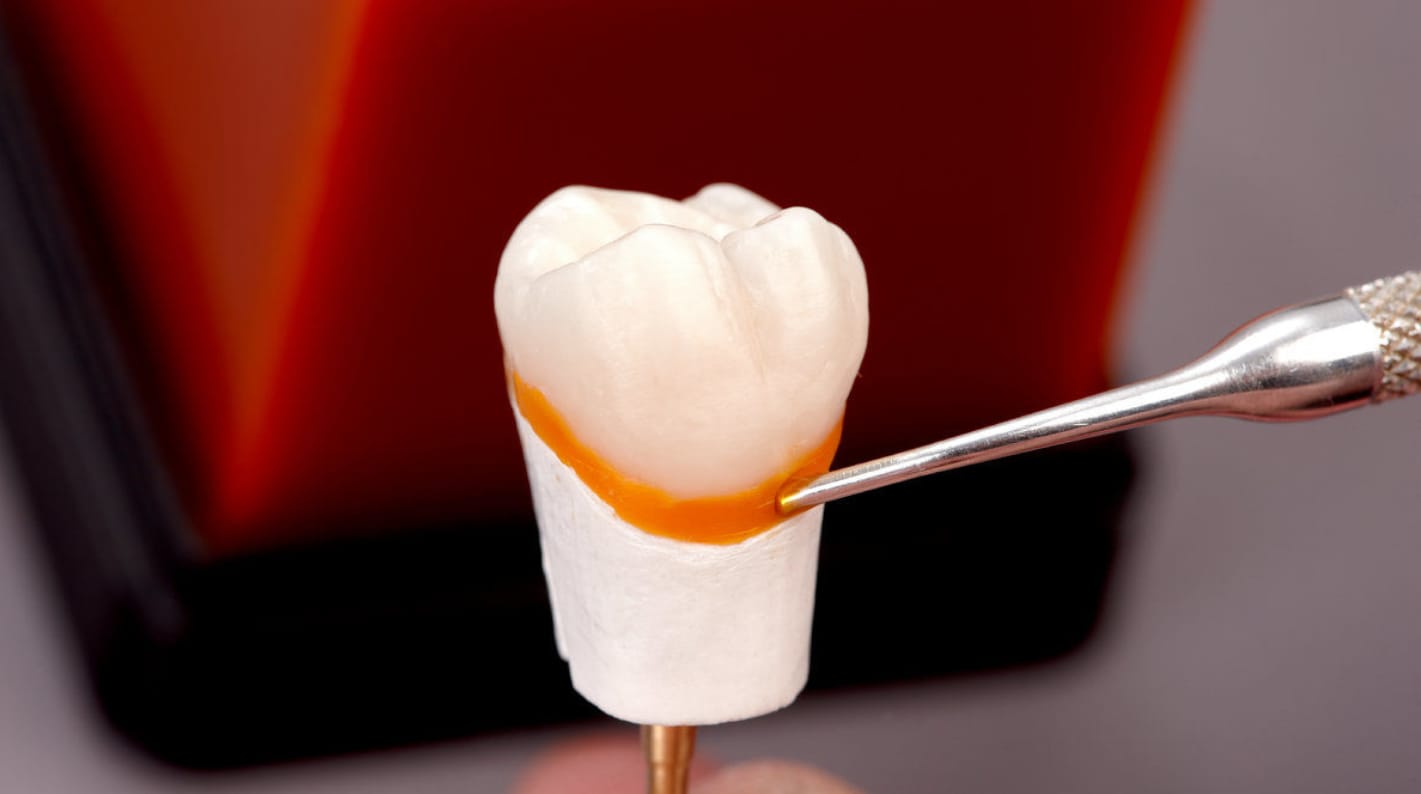
Dental waxes are chemical polyesters of fatty acids and alcohol forming hydrocarbon chains, that is, chains of carbon atoms linked to each other and to hydrogen atoms or other radicals. There is a wide variety of waxes for dental use and in general terms, we could say that most of them are made up of a mixture of waxes of animal, vegetable and mineral origin, as well as other products such as oils, fats, gums, resins, synthetic waxes and dyes.
The different types of dental waxes share the same physical properties:
- Melting range: Dental waxes are made up of different molecules and although they are similar to each other, they have different molecular weights. This property means that, instead of having a specific melting point, they have melting intervals.
- Thermal expansion: Dental waxes expand with increasing temperature and contract with decreasing temperature.
- Fluidity: It is what happens when the molecules slide over each other. The degrees of fluidity vary according to the type of wax, temperature and time.
- Residual stress: Cooling the wax under compression forces the atoms and molecules closer together and reheating the wax releases the stress, causing a dimensional change.
- Ductility: If you increase its temperature you can stretch the wax like a wire.
- Distortion of the wax pattern: Distortion increases with time and also depends on the storage temperature. This occurs because the residual stress developed during the fabrication of the wax pattern is released.
Types of dental waxes and classification
We can classify waxes according to their use as follows: wax for patterns, for processing or for printing.
Pattern wax
There are three main types of dental pattern waxes: wax for modelling fixed prostheses, for casting and for base plates.
1. Wax for inlays or wax for modelling fixed prostheses
Inlay wax or wax for modelling fixed prostheses is used to construct the shape of a dental restoration on a die previously prepared on a plaster model, which then, through a laboratory process, will transform this wax pattern into a final restoration made of a resistant material such as a metal alloy or porcelain. In simple terms, this process consists of creating a wax pattern with the desired shape, then coating it with plaster-silica or another type of refractory material to make a mould with a casting hole that connects the outer surface of the mould to the pattern. The wax is removed by heating and melting it, and finally, the mould is prepared to receive the molten alloy.
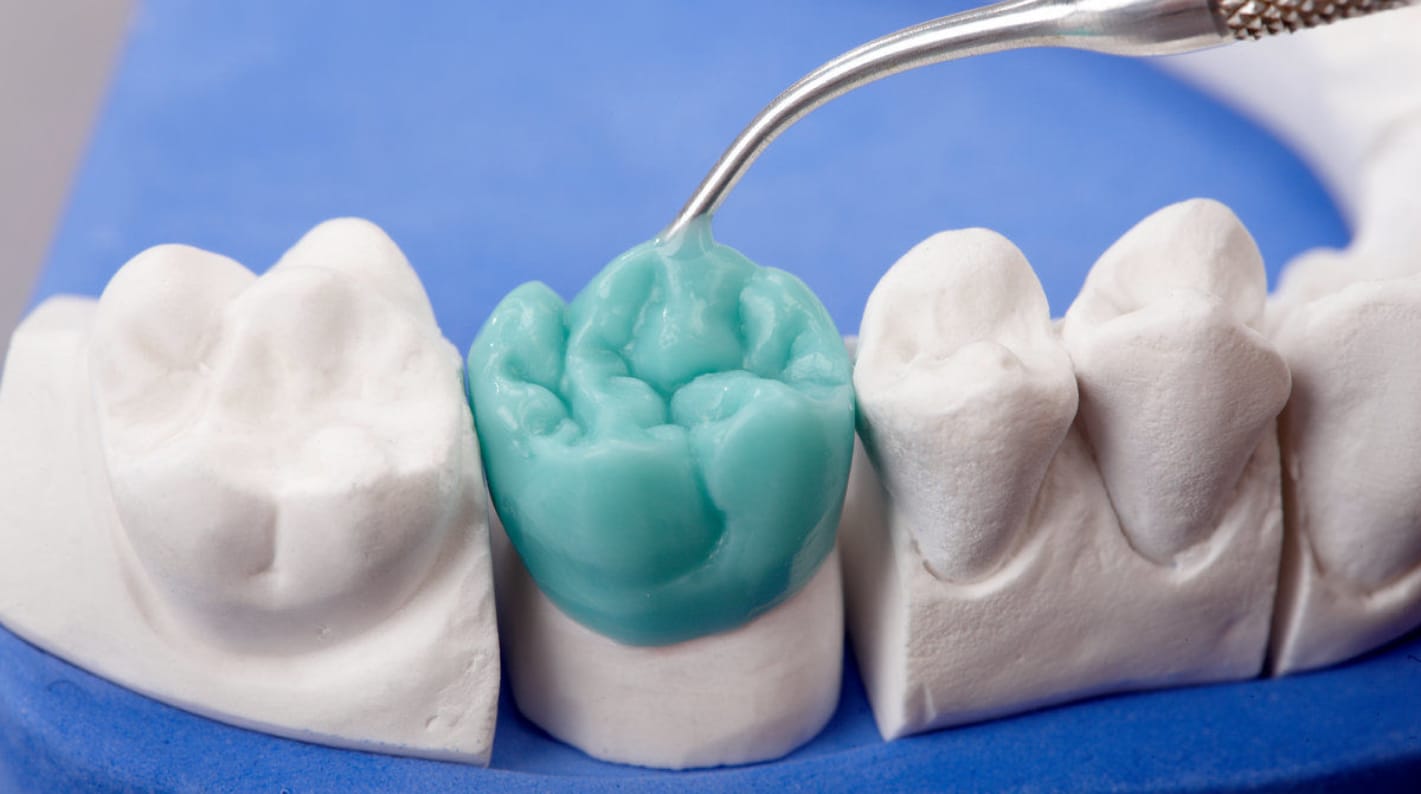
These waxes for modeling fixed prostheses, such as crowns or inlays, are usually available in different colors that contrast with the die, making them easier to identify. One of their most important properties, and what makes them unique, is that they can be easily modeled without chipping or flaking. This is essential when choosing them.
Regarding their composition, paraffin is usually the main component, making up 40 to 60% of their weight. However, since paraffin tends to flake and does not have the smooth, glossy surface required for an inlay wax, the remaining weight must consist of other waxes and natural resins as modifying agents.
There are two types of inlay waxes:
- Type I: It is harder, used directly in the mouth, and has low flow levels.
- Type II: It is softer, used indirectly on the plaster model, and is more fluid.
What to look for when choosing a good modeling wax?
Modeling wax for fixed prostheses, in its soft state, should be free of lumps, indicating that it is composed of ingredients that blend uniformly. The color of the inlay wax should contrast with the mold; this defined contrast helps in carving more precise margins.
Waxes with excess paraffin should be avoided. When the wax is bent and molded after softening, no flaking should appear on its surface; the surface should be smooth. Furthermore, it should be capable of being carved to a very thin layer; it should not flake off during carving, as this would prevent an accurate pattern. Finally, it is important that the chosen wax provides a rigid wax pattern.
2. Casting Wax
The pattern for the metal bases of removable partial dentures and similar appliances is made with casting waxes. Wax sheets are used to establish a minimum thickness in certain areas of the base, such as the lingual and palatal bars, and to achieve the desired contour on the lingual bar. They are also used to make preformed elements for clasps and retainers of different sizes.
There are 3 different types of casting waxes:
- Class A: number 28, pink
- Class B: number 30, green
- Class C: smooth shapes, blue
What to look for when choosing a good casting wax?
Mainly, that they are sticky, as this allows them to maintain their position and adhere to the model without the need for wax adhesives. The thickness and type of roughness should be chosen according to the work to be done.
3. Baseplate Wax
Baseplate wax gets its name from the fact that it is used on the base of the denture to define the vertical dimensions, the occlusal plane, and the initial shape of the arch when fabricating a complete denture. It is usually pink, which provides an aesthetic appearance during the initial construction of the denture before it is processed. With this wax, the desired shape of the denture can be modeled after the teeth are placed. Therefore, the modeled wax establishes the mold for the final acrylic denture.
It is essentially composed of paraffin, usually in a proportion of 70 or 80%, 12% beeswax, 2.5% carnauba wax, 3% natural or synthetic resin, and 2.5% microcrystalline or synthetic waxes.
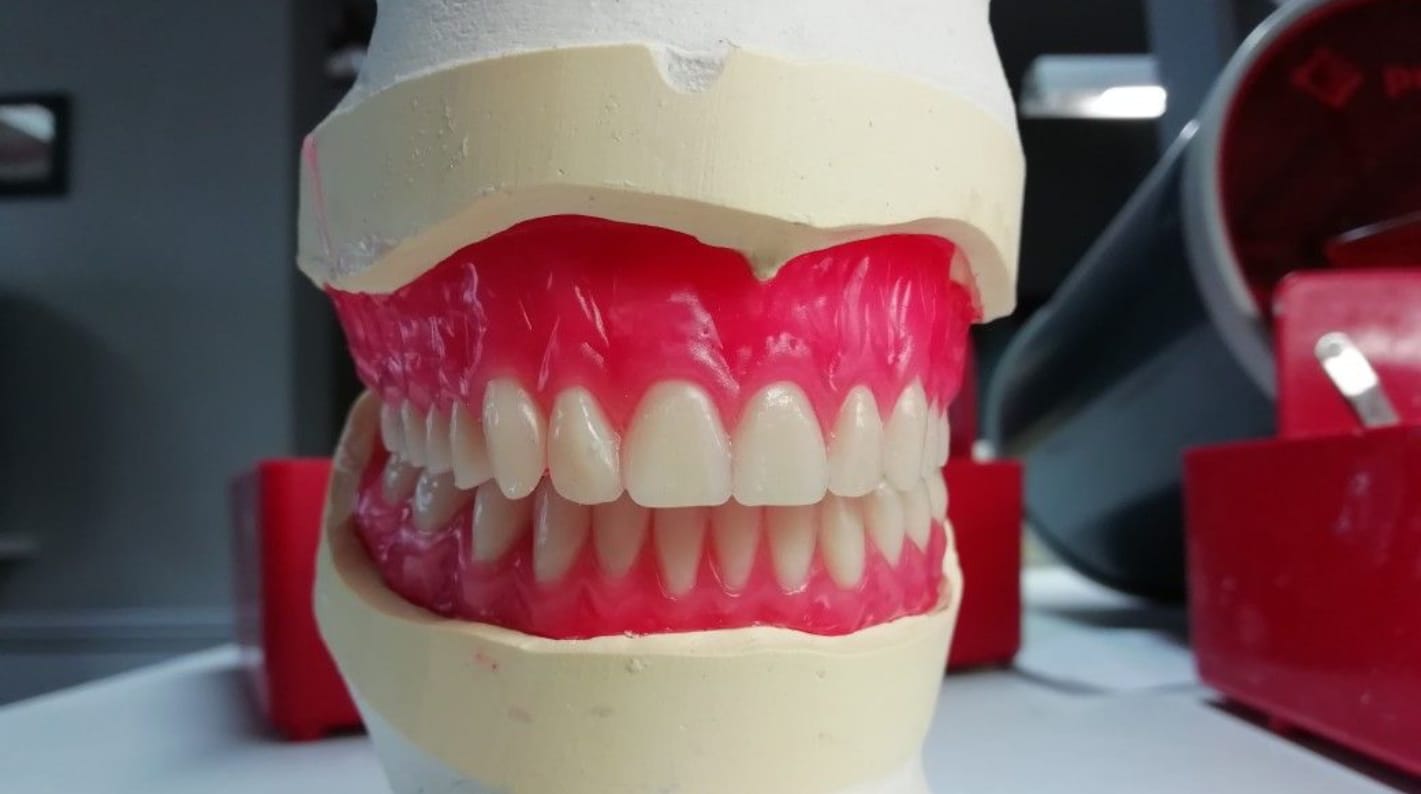
There are 3 types of baseplate wax:
- Type I: soft, used for contour and veneer preparation.
- Type II: medium, used for creating patterns inside the mouth in temperate climates.
- Type III: hard, used for creating patterns inside the mouth in warm climates.
What to look for when choosing a good baseplate wax?
The key to choosing a good baseplate wax is its flowability, which is especially important in waxes used to fabricate patterns that are tried in the mouth. Make sure you choose a wax that is not excessively flowable, as this could induce changes in vertical dimensions and occlusion. We also recommend choosing a wax that is easy to work with in your climate.
Processing Wax
Dental processing waxes are primarily of three types: molding wax, utility wax, and impression correction wax.
1. Molding Wax
Molding is a procedure used to surround the impression material and its base to confine the plaster and define a shape and thickness in order to minimize trimming of the model. It also ensures the correct reproduction of the impression in terms of its peripheral seal.
The walls of the mold are made with molding wax, which has the particularity of being able to easily adapt around the impression.
What to look for when choosing a good formwork wax?
The most important thing about a formwork wax is that, when flamed, it produces a smooth, shiny surface that is flexible at 21°C but maintains its shape at 35°C. It should also bond easily to the plaster and, of course, not melt from the heat emitted by the plaster during its setting process.
2. Utility Wax
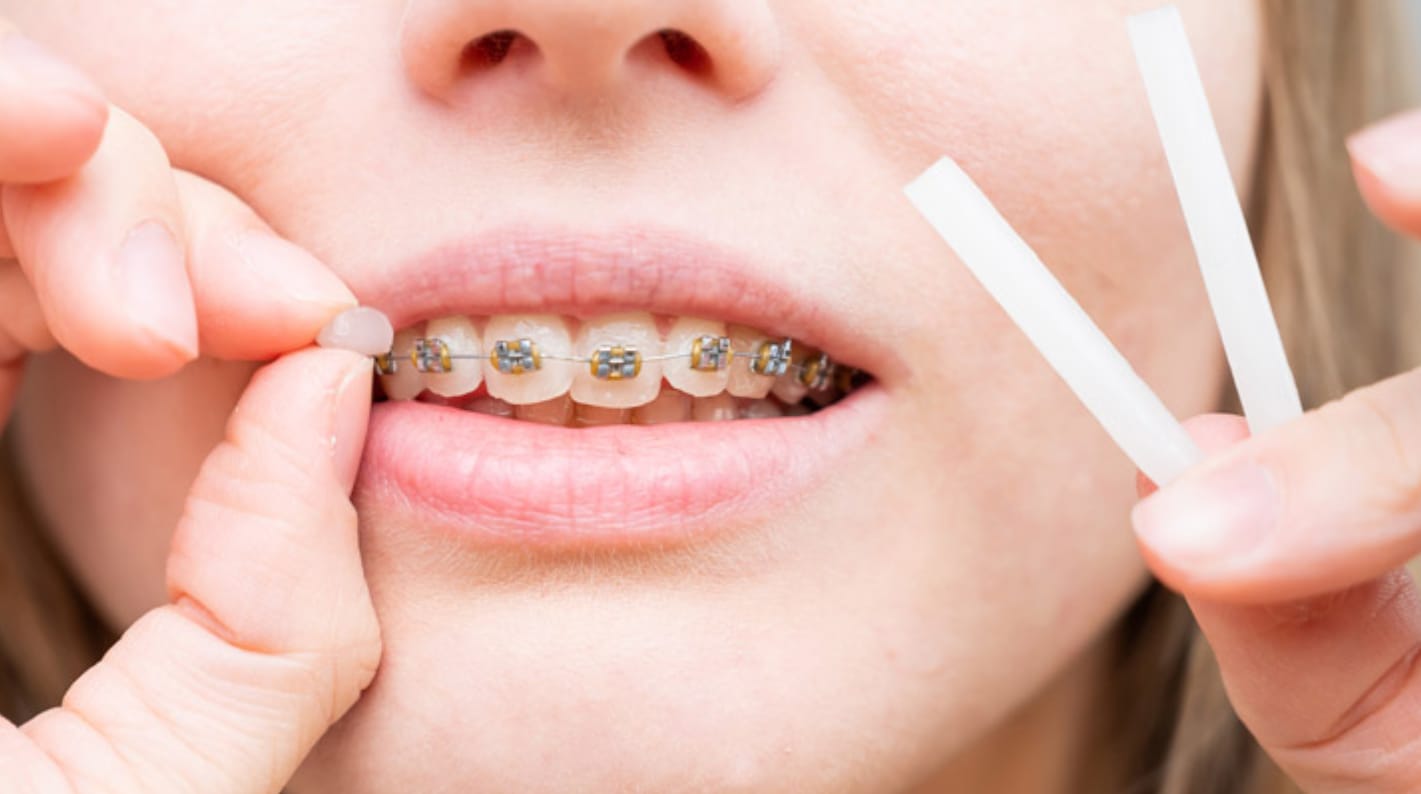
Utility wax, also known as utility wax, is an adhesive wax used to prevent warping and distortion of the material. It is usually available in the form of red or orange bars or sheets. It is primarily composed of beeswax, petroleum jelly, and soft waxes. Also included in this category are orthodontic waxes, which patients use by making small balls and placing them on the brackets, especially in the early stages of treatment, to protect the mucosa and prevent chafing.
What to look for when choosing a good utility wax?
One of the most important things to consider when choosing a utility wax is that it should be flexible and sticky at 21 to 24°C and also be able to adhere well for repairing small imperfections and filling gaps.
3. Sticky Wax
Sticky waxes are used to temporarily fix metal or plastic parts in place. They can also be used to repair structures, fix models in the articulator, and hold bridges and dies. They are usually sold in dark yellow sticks.
Their composition consists of a mixture of waxes and resins, rosin, beeswax, and dammar gum.
What to look for when choosing a good sticky wax?
To choose the best sticky wax, we must consider that it is sticky in its molten state and capable of adhering tightly. Furthermore, it should leave no more than 0.2% residue after burning and have very low shrinkage, ideally no more than 0.5%, when cooling from 42 to 28°C.
Impression wax
Impression waxes can be classified into two types: wax for correcting the impression and wax for bite registration.
1. Impression Correction Wax
Impression correction wax is used to coat the impression and come into contact with the soft tissues in their functional state for recording purposes. It is composed of hydrocarbon waxes such as paraffin and ceresin, and may contain metallic particles. The wax is fluid at 37ºC and deforms when removed from the mouth.
What to look for when choosing a good correction wax?
Make sure the correction wax you choose is soft and comfortable to avoid irritation or discomfort to the patient's oral mucosa. It is also important that it has good adhesion and hold to provide an optimal fit.
2. Bite Registration Wax
Bite registration wax is used to accurately fit opposing quadrant models. Bite registrations are normally made with No. 28 casting wax or baseplate wax, and there are also special bite registration waxes that may contain beeswax, hydrocarbon waxes, paraffin, or ceresin, and some include aluminum or copper particles. The flowability of different bite registration waxes varies between 2.5% and 22% at 37°C, meaning they may deform when removed from the mouth.
What to look for when choosing a good bite registration wax?
A bite registration wax should not shrink or distort as it hardens at room temperature. It should also be easy to use and resistant enough to be repositioned on the patient's teeth if the accuracy of the record needs to be checked. Ideally, these types of bite registration waxes should be rigid at room temperature and soft at working temperature without losing their properties, in order to obtain a clear and accurate cusp impression.
Check out the best-selling dental waxes:
Dental waxes are highly versatile materials that undoubtedly facilitate daily work in the dental clinic and laboratory. Now that you've become a true expert in dental waxes, we're sure it will be even easier for you to find the one you need.
Remember that at Dentaltix we have a wide variety of types and brands of dental waxes, we invite you to take a look. If you have questions or there is something we can help you with, do not hesitate to contact us and also follow us on our social networks to continue reading articles of interest to you. Until next time!