In dentistry, knowing the theory is not enough: professional skill is achieved through constant practice. However, practising directly on patients is not always possible, nor is it recommended in the early stages of learning. To meet this need, tipodonts and dental phantoms have become essential tools.
These simulators allow for repeated, safe and controlled training. Thanks to them, students can make mistakes without fear, correct errors and repeat the same procedure as many times as necessary until they master it. At the same time, they offer professionals and teachers a practical way to teach techniques, explain treatments and perfect skills without any risk to the patient. From students who are just beginning to familiarise themselves with dental anatomy to professionals pursuing postgraduate studies in implantology or surgery, everyone benefits from the use of these teaching solutions, which act as a bridge between theory and real-world clinical practice.
Let's explore what dental models and phantoms are, their differences, the most common types, and how to choose the model that best suits each stage of training.
What are tipodonts and phantoms and what are they used for?
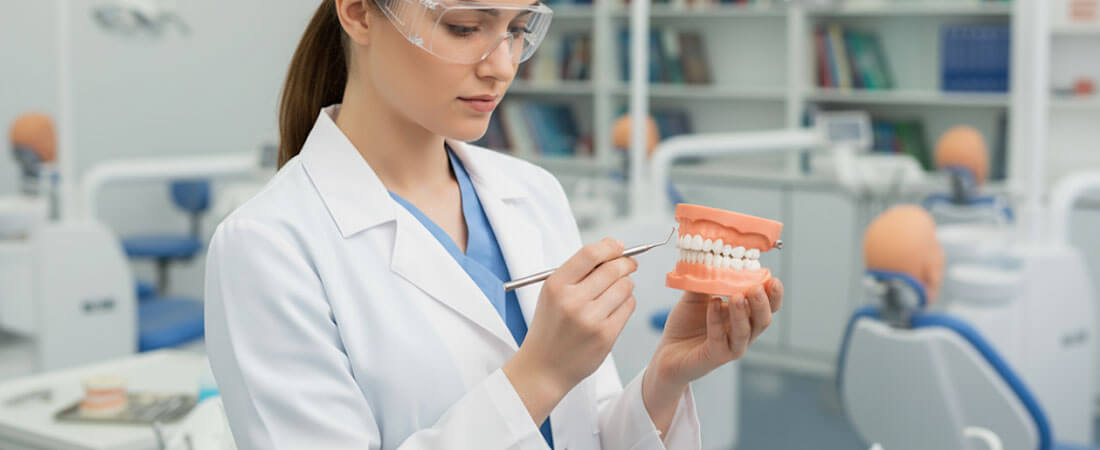
The dental tipodonto is a model that accurately represents the oral cavity. Its design can vary from very simple versions to highly sophisticated models, but in all cases they fulfil the same purpose: to faithfully reproduce the dental arches so that students can practise on them. Depending on their characteristics, tipodonto models can be used to practise carving techniques, cavity preparation, restorations, endodontics, prosthetics or orthodontic procedures. They are also widely used in dental clinics as a teaching tool to show patients how a treatment will be carried out.
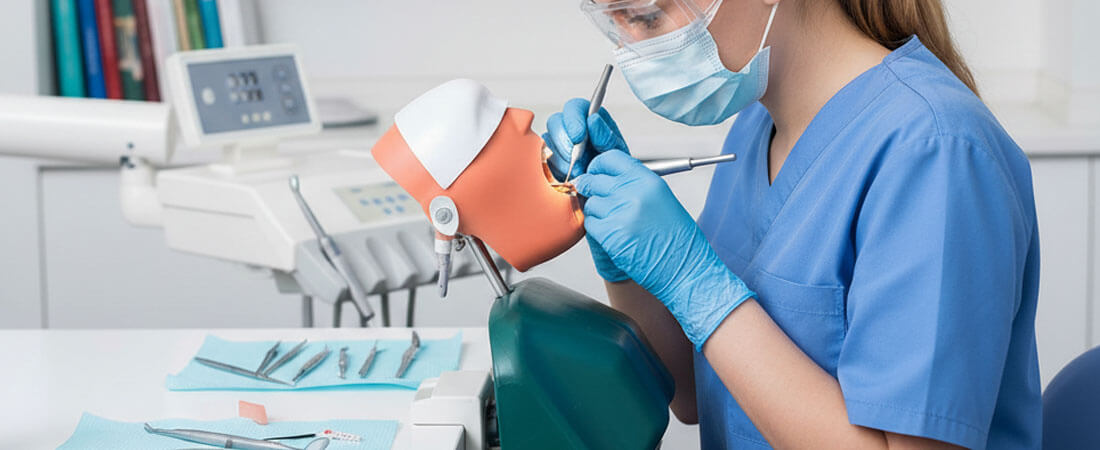
The dental phantom, on the other hand, goes a step further in terms of realism. It is not just an isolated dental arch, but an artificial head that includes a typodont inside. This assembly can be mounted on a table, a dental chair or an articulated arm, allowing the real situation of a patient in the clinic to be reproduced. In this way, students not only practise the technique itself, but also essential aspects such as ergonomics, working posture, the use of indirect vision with a mirror and coordination with instruments in complicated positions.
Difference between a dental model and a phantom
Although they are sometimes confused, the truth is that dental models and phantoms serve different and complementary functions. The typodont is, in essence, a representation of the mouth and teeth, a very valuable tool for learning dental techniques. The phantom, on the other hand, is a more complete clinical simulator that incorporates the typodont into a realistic environment: the head of an artificial patient, placed in a position that mimics that of a dental chair.
It could be said that the tipodonto is the basis on which technical skills are trained, while the phantom adds the practical and ergonomic dimension that prepares the student to make the final leap to the real clinic.
Types of dental models and phantoms
There is a wide variety of dental models and phantoms, and each model responds to specific educational needs. Knowing them in detail is essential to making the right choice according to the stage of training.
Types of dental models
- The standard typodont is the simplest and most economical. These are complete arches with fixed teeth, designed for early dentistry courses, where the focus is on learning dental anatomy and performing initial carving or exploration practices. Their main limitation is that, as they do not have interchangeable teeth, once the teeth are worn out, the entire model must be replaced.
- More advanced are the Frasaco-type typodonts, which originated in Germany and are widely used in European universities. These models stand out for their anatomical precision and the durability of their materials. In addition, they allow teeth to be removed and exchanged, making it possible to repeat the same practice without having to change the entire set.
- Also widely recognised worldwide are Nissin-type tipodonts, manufactured in Japan. They are famous for the realism of their soft gums and the quality of their materials, which faithfully reproduce the resistance of tissues. Nissin models are available in specific versions for different specialities, such as orthodontics, endodontics and prosthetics, and are used in faculties around the world.
- As students progress in their training, they can use specialised tipodonts, designed for very specific practices. There are typodonts designed for orthodontics, with brackets already cemented in place; for endodontics, with simulated root canals; for implantology, with artificial bone structures; and for periodontics, with soft, removable gums that allow for probing or surgical procedures. These models are particularly useful in master's and postgraduate courses.
Both Frasaco and Nissin are brands that have become standard in the dental industry; both also feature interchangeable teeth.
Take a look at the best-selling dental models:
Types of phantoms
A very practical way to classify phantoms is by their type of anchorage, as this determines the environment in which they can be used and the degree of realism they offer.
- Table-mounted phantoms are the most accessible and easy to use. They are secured to a stable work surface using clamps or screws, making them ideal for laboratories and training rooms, as well as for students who need to practise at home. Their main advantage is their simplicity and stability, although they do not replicate the experience of working on a dental chair.
- Dental chair-mounted phantoms are installed directly on the chair using specific adapters. This configuration allows for a highly accurate reproduction of the real clinical situation, as the artificial patient's head is placed in the same position as a patient undergoing treatment. In addition, they take advantage of the chair's movements (recline, height, tilt) to practise different working positions.
- Phantoms with an articulated arm support or manikin are mounted on an arm or structure that simulates a human torso. They offer mobility and the ability to rotate or tilt the head, facilitating access to different working angles. This type of phantom is common in dental schools that have preclinical classrooms equipped with individual mannequins.
- Modular or adaptable phantoms offer the best of both worlds. Thanks to interchangeable accessories, they can be attached to a table, a dental chair or an articulated arm. Their main advantage is their versatility, as they accompany students throughout their training, adapting to different practice environments.
What to choose if you are a dental student
Choosing between one type of tooth model or another, or deciding which type of phantom is most suitable, depends largely on the level of training and the environment in which the practical training will take place.
In the early stages of training, when the main objective is to learn about dental anatomy and take the first steps in carving or restoration techniques, it is best to start with a standard typodont. These models are usually more affordable and sufficient for familiarising oneself with the artificial mouth without the need for a complete clinical environment. For those seeking greater realism from the outset, Frasaco or Nissin typodonts with interchangeable teeth represent a more lasting investment, as they allow for repeated practice without having to replace the entire model.
As students progress through their studies and begin clinical courses, dental phantoms are incorporated, which are provided by the educational institution. If practical training is carried out in a laboratory with solid tables, a tabletop phantom is sufficient and offers good value for money. On the other hand, if a dental chair is available at the faculty or in the work environment, a chair-mounted phantom will provide greater clinical realism, as it allows the exact ergonomics of a real consultation to be reproduced. In universities equipped with mannequins or articulated arms, it is best to take advantage of this infrastructure with a phantom compatible with an articulated support, which allows the head to be rotated, tilted and moved closer according to each procedure. Finally, for students who frequently change environments (e.g., practical training at the faculty and studying at home), the most versatile option is a modular or adaptable phantom that can be attached to a table, chair or manikin thanks to interchangeable accessories.
At more advanced stages or in postgraduate and specialisation courses, specialised dental models (for endodontics, implantology, periodontics or orthodontics) and phantoms with soft or surgical tissues offer a much higher level of detail, reproducing clinical situations that require maximum precision. These models are ideal for those who need to train in conditions very similar to real practice and perfect specific techniques.
It is also essential to take into account the recommendations of the university or study centre, as in many cases there is a specific model used in class and it is advisable to ensure that it is compatible with academic practices.
Dental models and phantoms are essential tools in dental training and professional development. They enable students to gain confidence and skill before treating real patients, and allow professionals to continue practising or teaching advanced techniques in a safe environment.
Each model has a specific purpose: dental models allow you to focus on direct practice on teeth and gums, while phantom models reproduce the complete clinical experience, including ergonomics and working postures. There are basic versions, ideal for beginners, as well as advanced and specialised models for clinical and postgraduate courses. The right choice will depend on both the level of training and the space available for practice, always taking into account the recommendations of the university or study centre.
In short, investing in a good dental model or phantom not only facilitates learning, but also better prepares students for daily professional practice. They are the indispensable bridge between theory and actual clinical practice, and a guarantee that every trainee dentist can develop their full potential safely and effectively.
That's all for today's article! We hope you found it helpful, and if you liked it, please feel free to share it. Follow us on social media to stay up to date with all the latest news from the dental sector and our special offers. See you soon!