Complete guide to dental thermoforming machines: What they are, how they work, and their uses in dentistry
Dental thermoforming machines have become an essential tool in the manufacture of splints, mouthguards, and other clinical devices made from thermoplastic sheets. Their ability to precisely adapt these materials to dental models has optimized both clinical and laboratory work, offering reliable and highly personalized results.
With the evolution of digital workflows and the incorporation of 3D-printed models, thermoforming has experienced remarkable progress. Current machines allow for precise control of temperature, heating time, and pressure, resulting in better-fitting, more stable devices with a faster and more standardized manufacturing process.
Let's explore what thermoforming machines are, how they have evolved, what they are used for in dentistry, and the protocol for using them correctly, providing a complete and up-to-date overview of their role in modern clinical practice. Don't miss it!
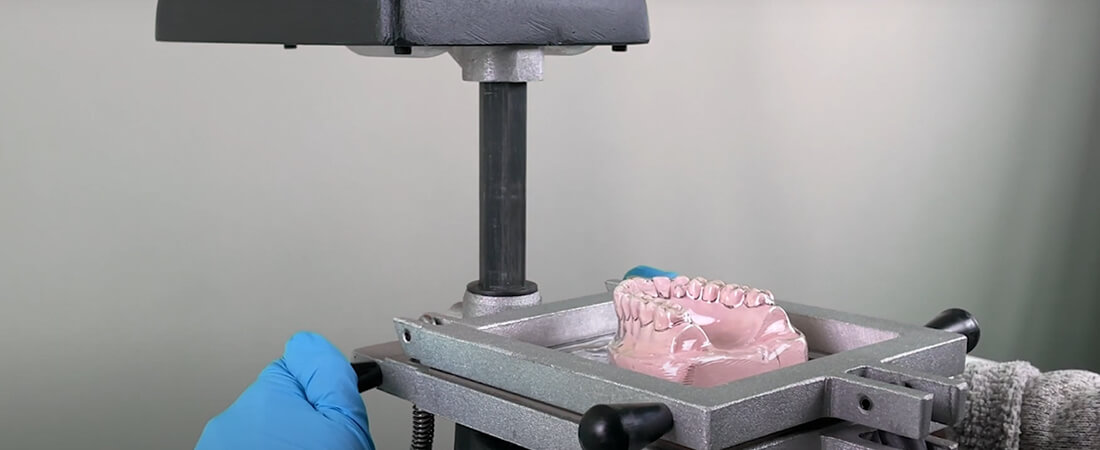
What are dental thermoforming machines?
Dental thermoforming machines are devices designed to heat a sheet of thermoplastic material and adapt it to a model, usually a plaster cast or 3D-printed model, using vacuum, pressure, or a combination of both. Their main objective is to obtain an exact copy of the patient's anatomy, which will serve as the basis for manufacturing various clinical devices.
Their operation may seem simple at first glance: the material is heated until it acquires a moldable consistency and then pressed onto the model. However, critical variables such as temperature, heat exposure time, the power of the vacuum or pressure system, the distance between the heating element and the sheet, and even the type of material used are involved in this process. Modern thermoforming machines allow these parameters to be controlled with a precision that guarantees homogeneous and reproducible results.
Evolution of Dental Thermoforming Machines
The first thermoforming machines used in dentistry were rudimentary, relying almost entirely on the operator's experience. The professional had to visually observe the material's behavior to estimate when it was soft enough, in addition to manually activating the suction system. This lack of control could lead to overheating, deformation, or uneven adaptation.
Over time, the industry began incorporating improvements that completely transformed the equipment. One of the most important innovations was the addition of digital controls that allowed for precise temperature regulation. Later, uniform heating elements appeared, preventing uneven heating of the sheet, along with automatic systems that detect the ideal moment for lowering or pressing the material.
Another significant improvement was the evolution of vacuum and pressure systems. While previously most machines relied solely on vacuum, which was sometimes insufficient for thick materials, today there are machines that combine vacuum with positive pressure, generating extremely detailed conformity even in very thick sheets, such as those used for sports protectors.
Thanks to these innovations, current thermoforming machines offer a quality of result that far surpasses the capabilities of the first models. And most importantly: they allow for faster, safer, and more reproducible work, something essential in modern dentistry.
What are they used for in dentistry?
The versatility of this equipment is one of the reasons why its use has become so widespread. Currently, they are essential in several specialties:
- In orthodontics, thermoforming machines are essential for the fabrication of retainers, simple aligners, baseplates, and mandibular repositioning devices. Their precision allows for the production of very snug and comfortable splints for the patient, reducing the need for subsequent adjustments.
- In restorative and aesthetic dentistry, they are used to create molds for mock-ups, splints for provisional restorations, teeth whitening trays, carving guides, and keys that aid in planning more conservative treatments. They are also used to manufacture custom trays precisely adapted to the patient's model.
- In the field of preventive dentistry, they allow the production of bruxism splints or sports mouthguards, where a specific thickness and a particularly firm fit are required to guarantee effectiveness and safety.
- Their use is routine in dental laboratories, where different types of splints, plates, or working templates are manufactured for multiple procedures. In fact, the speed and predictability of thermoforming have led many laboratories to incorporate these machines as an essential part of their daily workflow.
Check out the best-selling thermoforming machines:
View all thermoplastic machines!
How is a dental thermoforming machine used?
Using a dental thermoforming machine combines precision, thermal control, and the correct selection of materials. Although each model may vary slightly in its operation, the thermoforming process follows a logical sequence that guarantees optimal results. The standard procedure, from model preparation to final finishing of the appliance, is detailed below.
1. Model Preparation
A good result starts with a suitable model.
- Cleaning and drying: The model must be completely clean, without any plaster or dust residue that could mark the splint.
- Base trimming: Trimming the base allows the splint to fit better, reduces stress, and improves the final aesthetics.
- Delineation of critical areas: Undercuts, retentive areas, and margins must be well-defined to ensure a precise fit.
- 3D-printed models: These are especially recommended due to their dimensional stability, strength, and ease of handling.
2. Selection of the Thermoplastic Sheet
The type of device to be manufactured determines the choice of material.
- Common Materials: PETG, EVA, polycarbonate, polypropylene, or multilayer laminates.
- Thickness: Thin sheets (0.5–1 mm) are used for aligners or whitening trays; thicker sheets (3–5 mm) for sports mouthguards and rigid splints.
- Transparency: Essential in aesthetic or whitening trays.
- Elasticity and Rigidity: These are selected according to the type of splint and the level of comfort required for the patient.
If you want to know more, you can read our blog article about thermoforming sheets here.
3. Heating the sheet
This is one of the most important phases of the process.
- Placement: The sheet is inserted into the corresponding ring or support, ensuring stability during heating.
- Thermal control: Modern equipment has sensors that ensure a uniform temperature.
- Material behavior: Visually, the sheet acquires a slight downward curve when it is ready to be molded; this phase is key to preventing overheating or deformation.
- Automatic cycles: Some machines adjust time and temperature according to the type of sheet, reducing manual intervention.
4. Adaptation to the model (vacuum, pressure, or both)
The way the sheet is applied defines the level of detail obtained:
- Vacuum systems: the sheet is suctioned onto the model, adapting precisely to its surface.
- Positive pressure: a bell or piston exerts pressure from above, achieving very homogeneous results even with thick sheets.
- Combined systems: offer the most complete fit, combining suction and pressure to capture every anatomical detail.
5. Cooling and Removal
Once the material has been adapted, it is essential to allow it to cool properly.
- Prevent deformation: Removing the splint prematurely can compromise its shape.
- Removal from the model: After complete cooling, the splint detaches easily without distortion.
6. Device Trimming
Trimming defines both the aesthetics and comfort of the final device.
- Marking the cutting line: typically 2 mm above the gingival margin in retention or whitening splints.
- Cutting instruments: special scissors, discs, or finishing burs depending on the material thickness.
- Correction of undercuts: check angles and possible overextension to avoid discomfort or fractures.
7. Finishing and Polishing
The final finish directly influences patient comfort.
- Edge Polishing: A smooth, rounded edge is sought that does not irritate the gingiva.
- Fit Verification: Before delivery, stability, pressure, and retention are checked.
- Targeted Adjustments: Small changes can be made with localized heat or fine polishing burs.
Thermoplastic machines have undergone a remarkable evolution, transforming from manual and somewhat inconsistent equipment into technologically advanced tools that guarantee precision, speed, and extremely reliable results. Their versatility has established them as an indispensable element in numerous dental specialties, enabling the manufacture of splints, mouthguards, aligners, and a wide range of devices with a level of detail difficult to achieve by other means.
Understanding how they work and learning to use them correctly allows you to maximize their benefits and obtain more durable, comfortable, and effective devices. Whether used in the clinical setting or the dental laboratory, thermoforming machines represent a key component in the modernization of current dental practice and in the continuous improvement of both digital and analog workflows.
That's all for today's article! We hope you found it helpful, and if you liked it, please feel free to share it. Follow us on our social media channels to stay up to date on all the latest news in the dental sector and our special offers. See you soon!